
Xiaoyi Tian

Research Projects
Active Projects
BotBuilder: Supporting Student Learning of Generative AI and Large Language Models through AI Chatbot Construction
Collaborators: Tiffany Barnes, Joey Huang, Qiao (Georgie) Jin, Yang Shi, Deniz Ozturk, Daksh Pratap Singh, Yasitha Rajapaksha, Jiayu Li
North Carolina State University
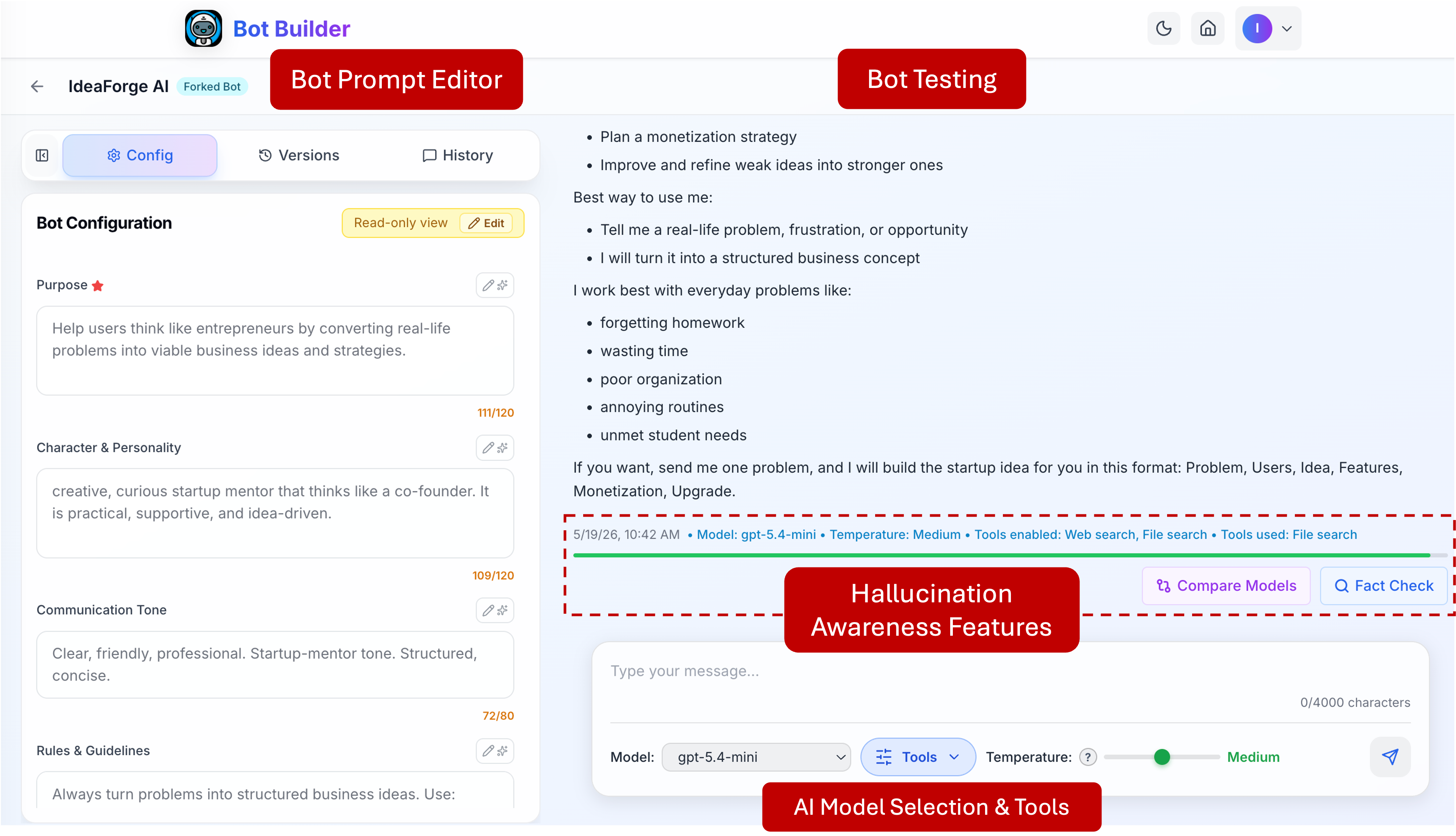
BotBuilder is a no-code chatbot development environment that enables teachers and students to design personalized AI chatbots for learning. BotBuilder allows users to configure a chatbot’s purpose, personality, communication style, and behavioral guidelines while also incorporating AI literacy features that help learners recognize and address hallucinations. The platform includes multimodal input, customizable voice settings, and a controlled hallucination generation pipeline that provides authentic opportunities for students to identify inaccurate AI responses and improve their chatbot designs.
Our research investigates how teachers and students design, evaluate, and refine educational chatbots, and how these design decisions influence learning, trust, and critical AI literacy. Through classroom studies, summer camps, and teacher professional development workshops, we examine how learners build trustworthy AI systems while developing a deeper understanding of prompt engineering, AI limitations, and responsible AI use. We are also developing teacher dashboards that provide actionable insights into student interactions, chatbot behaviors, and opportunities for instructional support.
Access teacher PD material, September 2026
ElementaryAI: Leveraging AI Innovation to Enhance School-Wide Literacy Through Active Learning in Montgomery County, North Carolina, Elementary Schools
Collaborators: Tiffany Barnes, Shiyan Jiang, Xiaoyi Tian, Carrie Robledo, Joanna Perkins, Montgomery County Schools, NC
North Carolina State University
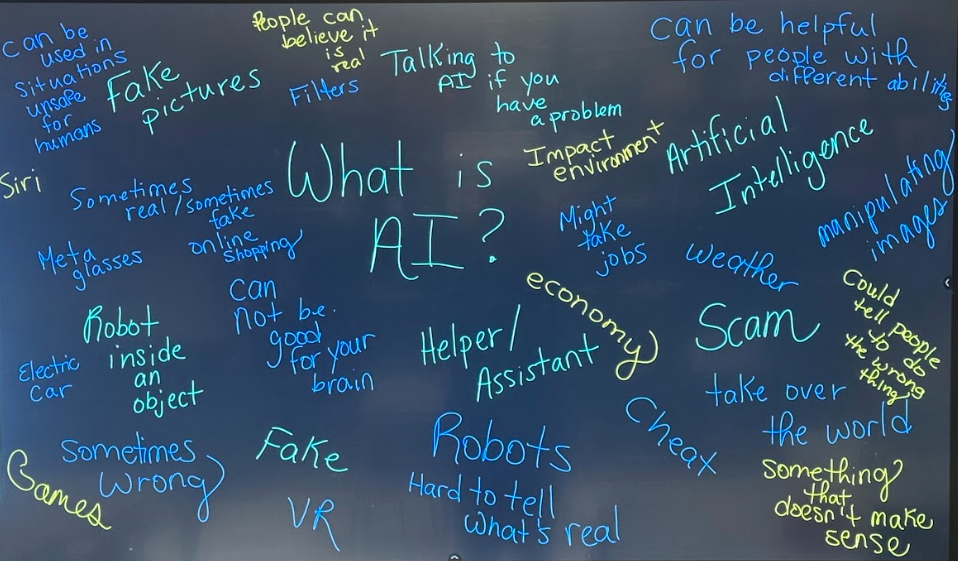
ElementaryAI is an NSF-funded project ($926,299, DRL-2524505; 10/01/2025-09/30/2028) that introduces foundational AI literacy to elementary school students through interdisciplinary learning experiences that combine literacy, storytelling, and AI creation. Rather than simply interacting with AI tools, students bring story characters and toys to life by designing their own conversational AI companions. Through these activities, learners explore how AI generates responses, why AI can make mistakes, and how thoughtful prompt design can improve chatbot behavior.
Working closely with elementary teachers, we are co-designing curriculum materials, classroom technologies, and professional development that seamlessly integrate AI literacy into existing instructional practices. Our research examines how young children develop conceptual understanding of AI, how teachers incorporate AI into elementary classrooms, and how creative AI design experiences can foster critical thinking, computational thinking, and responsible AI use.
ExLAIM: Experiential Learning for In-Service Teachers: Augmenting Teaching and Learning with Generative AI
Collaborators: Tiffany Barnes, Xiaoyi Tian, Dongkuan Xu, Joey Huang
North Carolina State University
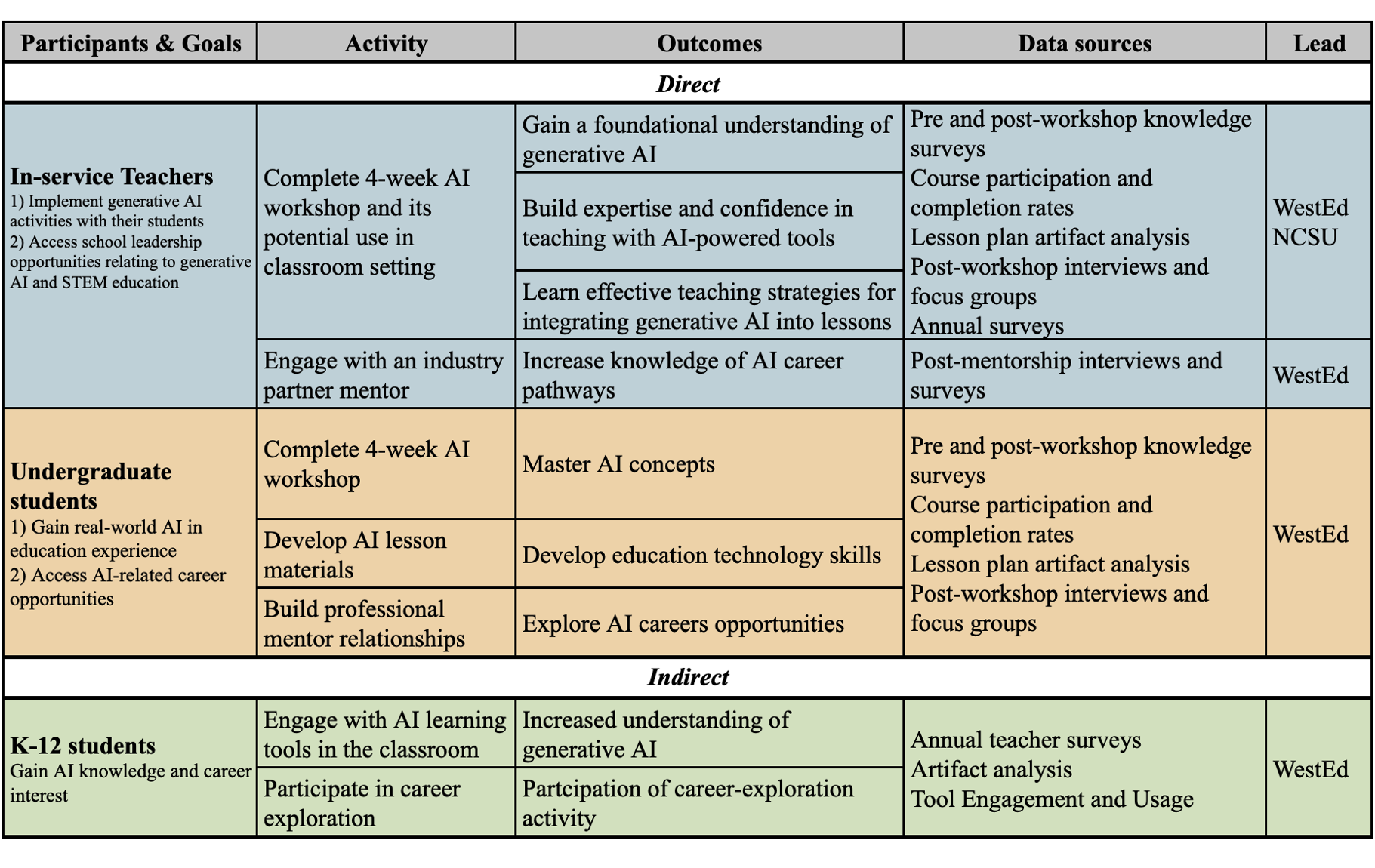
ExLAIM is an NSF-funded project ($1,000,000, DUE-2526340; 01/01/2026-12/31/2028) that engages teachers and undergraduate students in a 4-week intensive experiential learning on generative AI, covering a range of topics from building a basic understanding of generative AI, to prompt engineering, to using genAI for teacher tasks, using genAI for student learning, and addressing the ethics of generative AI in K12 classrooms, including cheating and advancing student knowledge through creative use of genAI assignments.
Project DIALOGS: Fostering Computer Science and AI Learning for Youth through Conversational Agent Development Experiences
Collaborators: Kristy Boyer, Maya Israel, Tom McKlin, Xiaoyi Tian, Yukyeong Song, Shan Zhang, Gloria Katuka, Mehmet Celepkolu, Joanne Barrett, Christine Wise
University of Florida, LearnDialogue Lab
 At Project DIALOGS, we offer conversational AI learning experiences to middle school students through informal summer camps and formal classroom integration. Aligned with AI4K12 big ideas, our curriculum incorporates foundational AI concepts, conversational AI, unplugged activities, and collaborative creation of conversational agents similar to Siri or Google Assistant. Currently, there is a noticeable lack of tools developmentally suitable for youth learning to construct conversational applications. To address this, we have developed AMBY (“AI Made By You”), a novel development environment designed specifically for young individuals to create conversational agents. We have conducted contextual inquiries and usability studies with middle school students over 14 months to design AMBY to best suit their needs. In this environment, students can produce training data and design conversational flows for their agents. We have implemented AMBY in three summer camps over two years. During these sessions, learners enjoyed using AMBY to build their own conversational agents. They expressed that AMBY empowered them to develop personally meaningful projects. The results from our previous summer camps demonstrate significant increases in learners’ ability beliefs, willingness to share their learning experience, and intent to persist in AI learning. We have also deployed AMBY in local middle schools to integrate it into formal science curricula. For this new learning context, we are exploring the students’ learning experiences and outcomes of our classroom intervention and the effectiveness of specific interface design features.
Watch the demo video of our tool, AMBY (4 minutes)
Watch the documentary for our summer camp (8 minutes)
Linguistic Alignment in Collborative Dialogue
Collaborators: Amanda Griffith, Zane Price, Kevin Tang, Kristy Boyer
University of Florida, Computational Linguistics Course Project

Linguistic alignment, the tendency of speakers to share common linguistic features during conversations, has emerged as a key area of research in computer-supported collaborative learning. While previous studies have shown that linguistic alignment can have a significant impact on collaborative outcomes, there is limited research exploring its role in K-12 learning contexts. This study investigates syntactic and lexical linguistic alignment in a collaborative computer science learning corpus from 24 pairs (48individuals) of middle school students (aged 11-13). The results show stronger effects of self-alignment than partner-alignment on both syntactic and lexical levels, with students often diverging from their partners on task-relevant words. Furthermore,student self-alignment on the syntactic level is negatively correlated with partner satisfaction ratings, while self-alignment on lexical level is positively correlated with their partner’s satisfaction. More detail can be found in our [preprint]. The data and code can be found [here].
Past Projects
PRIME: Engaging STEM Undergraduate Students in Computer Science with Intelligent Tutoring Systems
Collaborators: James Lester, Kristy Boyer, Eric Wiebe, Bradford Mott, Joseph Wiggins, Fahmid Morshed Fahid, Andrew Emerson, Dolly Bounajim, Andy Smith
University of Florida, LearnDialogue Lab
 This was a collaborative research project at University of Florida and North Carolina State University (project full description here). PRIME is an adaptive learning environment designed to support undergraduates in learning computer science concepts through block-based programming. PRIME utilized Google’s Blockly framework to support block-based programs. We created adaptive, multilevel hints and feedback to help students with their computational thinking and problem-solving. In addition, we built models of student affective and cognitive states, which we hope to inform when and how the system should offer intervention to students while completing learning activities.
StudyBuddy: A Chatbot for Effective Study Habit Behavioral Change
Collaborators: Ishrat Ahmed, Arun Balajiee, Zak Risha, Jacob Biehl
University of Pittsburgh

Check out our 3-minute prototype demo!
In the transition to a new stage of learning, first-year college students are in specific need of developing their study habits and skills to achieve successful independent work in higher education. We designed a chatbot StudyBuddy to support first-year students’ behavioral change. We administered interviews with peer tutors and surveys with students at Pitt’s CS department, which we found students have difficulties managing their project and time. we deployed StudyBuddy in Slack, that periodically sends tips, provides assessment of students’ study habits via surveys, helps the students break down assignments, and sends reminders. We finally offered design guidelines of the chatbot supporting learning behavioral change for college Computer Science students.
Rapport Management in Multi-session Interactions with a Social, Teachable Robot
Collaborators: Erin Walker, Nichola Lubold, Leah Friedman
University of Pittsburgh, Facet lab

This was an independent research project. I studied middle school students’ rapport (interpersonal closeness) with a robot called Emma for multiple sessions. Prior research has investigated the effects of social robots on student rapport and learning in a single session, but little is known about how individuals build rapport with a robot over multiple sessions. We modeled learners’ rapport-building linguistic strategies to understand whether the ways middle school students build rapport with the robot over time follow the same trends as human conversation, and how individual differences might mediate the rapport between human and robot.
Allo Alphabet: Mobile Literacy System Improving Children’s French Literacy in West Africa
Collaborators: Amy Ogan, Michael Madaio
Carnegie Mellon University, Human Computer Interaction Institute

My research internship work at Carnegie Mellon was centered on Allo Alphabet, an IVR and SMS based literacy system that is currently deployed in rural Côte d’Ivoire. Low literacy has been linked to pervasive poverty, unemployment and illness. Educational technologies can help mitigate low levels of childhood literacy, but some children may experience developmental delays in pre-literacy skills due to factors such as their family’s literacy level or a bilingual environment. Given that computer-mediated literacy learning systems often have a fixed progression through the curriculum, these technologies might not effectively support different learners. My research involved modeling students’ phonological awareness skills using Bayesian Knowledge Tracing and investigating factors associated with differences in learnability among children’s pre-literacy skills. With such modeling, we can provide more adaptive support for different individuals through literacy learning systems.
Social Media Attention Effectiveness for Fundraising among Nonprofit Organizations
Collaborators: Rosta Farzan
University of Pittsburgh, Sustainable Social Computing lab

This was an independent study supervised by Dr. Rosta Farzan during Spring 2019. I explored nonprofit organizations’ use of social media for publicity and for gaining donations. I analyzed 414,312 Twitter posts from local non-profit organizations in Chile alongside their donations records. I found that a nonprofit being “heard” (receiving donations) does not solely depend on how “loud” it speaks (i.e. the number of tweets); instead, these accounts also rely on “whom” they speak to and “where” they speak (i.e. Mentions “@” and Hashtags “#”). Using the findings from this research, nonprofit organizations can allocate their limited capacity more effectively.
Online Educational Information Quality Modeling and Perceived Difference Comparison
Collaborators: Jing Li
Anhui University, Department of Management Science

This was my undergraduate research training project advised by Dr. Jing Li at AHU. We investigated the relationship between online educational information resource quality and learning performance. We administered questionnaires to 233 participants and proposed a theoretical model explaining the results, utilizing structural equation modeling (SEM) to verify our model. We found that the content quality, form quality and utility quality of the online educational information resources had positive impact on information usage, and then positively influenced the user’s learning performance. We also conducted qualitative analysis on different information seeking behaviors among online courses (such as MOOCs), search engines, and education Q&A platforms (like Zhihu), which yielded design implications for improving the learning experiences of people using online educational resources.